
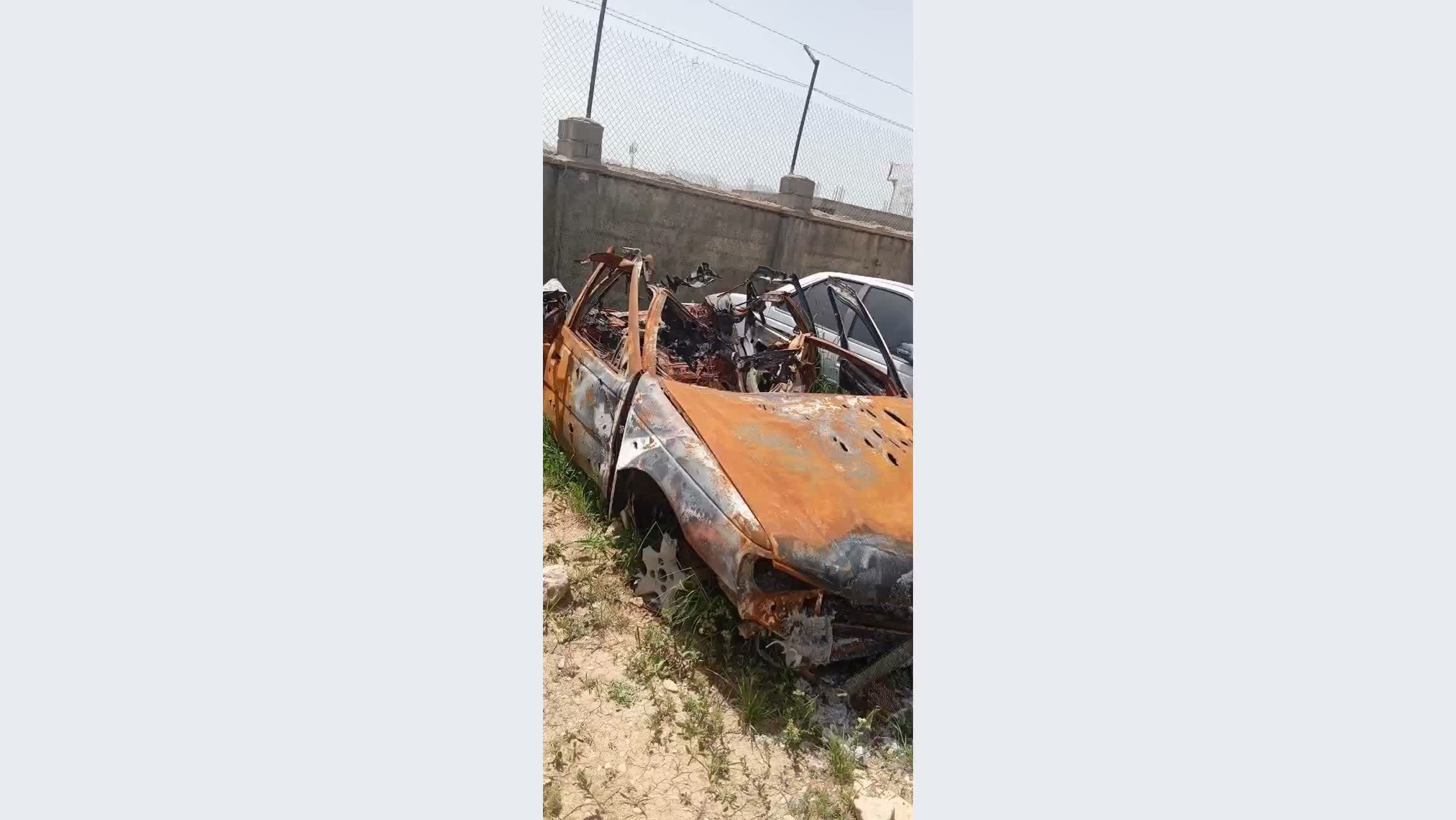
Illness had long since taken away Omid’s father’s ability to work, and now it fell to Omid to take his place, with seasonal worker and day jobs. After high school, he gave up his studies to support his family and to save for his wedding. He and his fiancée, Sahar, were supposed to hold their wedding after Ramadan this year.
The Farajzadeh family has four children, and Omid was the third: 26 years old, a worker. A few days before the strikes on two areas near Yasuj, one of Omid’s sisters, a nurse living in Tehran, decided, in the middle of the war, to take a leave and come to her parents’ house. The night she arrived in town; a small gathering was held at her father-in-law’s house. It was the last family gathering Omid would ever attend. A few hours after the gathering, Sahar, Omid’s young fiancée, called him and asked him to take her to their house to see his sister. Sahar’s home was a little way outside the city of Yasuj, in the Sepidar area. The road to it ran past a recreational spot known as “Cheshmeh Salam,” a mountain near the village of Vezg, in Kakan Rural District.
“On that road, a drone hit my son’s car. Another car came to help the two of them, and it was hit too.” Hossein, Omid’s father, knows the story of his son’s last moments: the minutes when an area near the village of Vezg was struck, when the car Omid used to carry passengers went up in flames, and when Omid and his fiancée lost their lives. His father says the attack happened in an area where there was no fighting, and that at that very moment another car arrived to help the two of them, but it was struck too.
“Omid’s martyrdom broke our backs.” Two hours after Omid left, his father called him, but his phone was off. There was no news from him until noon the next day, when his father heard from neighbors that two people had been killed in a strike the night before, near Cheshmeh Salam in the Kakan area.
They said that the people in two other cars had also been killed, on a mountain near Yasuj. Two of them asked Omid’s father: “Where is your son?” He had no answer, except to say that his phone was off. At two o'clock that afternoon, the local police station called Omid’s family. All that remained of Omid and his car was a single license plate, yet the police managed to locate his family. The following day, the bodies of Omid and Sahar were laid to rest alongside the other victims.
Official sources, including The Iranian Red Crescent Society, say that in the early hours of April 5, three locations in Kohgiluyeh and Boyer-Ahmad province were targeted: the Kuh-e Siah area; Cheshmeh Salam, near Kakan Rural District; and an area near the village of Vezg, outside Yasuj, close to a fish farm. According to published reports, 10 people lost their lives in these attacks, some of whom were civilians. At the very time that areas in Kohgiluyeh and Boyer-Ahmad Province were coming under attack—roughly 291 kilometers north of Yasuj—the sound of drones echoed across the Mahyar Plain in Isfahan; by the following morning, 10 members of the nomadic community from Jarqavieh Nasrabad had also been killed.
The day after the attack, among the civilians killed at Cheshmeh Salam in Kakan, near Yasuj, the bodies of two other young men were identified: Hamed Shafikhah and Mehrshad Bashib (Zolghadr). They had arrived only an hour before the attack, and in the same minutes that Omid and Sahar’s car was burning, their tent at Cheshmeh Salam was struck.
It was around 11 p.m. on April 4 when Hamed, having finished his shift at the Iranian Clothing Store in Yasuj, stepped out of the shop to head home. He held a high school diploma in the humanities and was working at the clothing store in Yasuj to help support his family.
Among the family members, the eldest brother, Hadi, knows more details about the night of the attack. from the moment Hamed and his friend decided to go to Cheshmeh Salam together, to the time their bodies were returned to the family. He knows that, two weeks before he was killed, his younger brother had a dream about his own death, a death in a meadow, exactly like the place where he was ultimately killed. "My brother was very good-natured and cheerful. He never hesitated to help others. It was as if his death had been revealed to him; he once mentioned in the family group chat, 'I will become a martyr.'"
On his way home, Hamed’s phone rang. It was Mehrshad, his childhood friend, asking him to go to Cheshmeh Salam in Kakan, a nomadic grazing area that at this time of year was green and empty of the tribes who migrate through it. That same night, American aircraft were flying so low that locals could see them with the naked eye.
At around 1:30 a.m. on April 5, a projectile struck the very spot where Hamed and Mehrshad had pitched their tent. Of the tent, only a few scraps of fabric remained; of the two young men, only their lifeless bodies. On the morning of April 5, as the bodies were identified, the local police station informed the Shafikhah family that their son had been killed. He was 25 years old, and “he was neither military, nor political, nor tied to the government. He had dreams, and he was in the prime of his youth.”