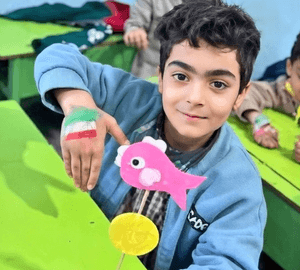
Makan Nasiri
Age at death
8
Gender
Male
Occupation
Student
City of death
Qazvin
Province
Qazvin
Death date
15 April 2026
Their story
On the morning of March 9, Makan left for school wearing his cream-colored shoes, a sports outfit, and his blue sweater slung over his shoulder. He was a first-grade student at Shajareh Tayyebeh School. That day, he had Persian, math, and physical education—the last class on his schedule.
He never made it to the final bell.
At 11:16 a.m., his mother, Asieh, received a call from his teacher asking her to come and pick him up. There were reports of an attack. She called the school driver. He was already on his way.
Then came the explosion.
A deafening blast tore through the school before she could reach it. By the time Asieh and her husband arrived, the roads were blocked. They ran the rest of the way on foot, toward a building that no longer resembled a school.
“I didn’t know where to go,” she later said. “I didn’t know where to look, or who to ask. Everyone was searching for someone.”They stayed there from late morning until 2:30 a.m. the next day.
Everyone pulled from the rubble was lifeless.
The attack killed 156 people—120 of them students. Among the dead were teachers, parents who had rushed to collect their children, a school driver, and even an unborn child. All but one were identified.
Makan was the only one who never came back.
For days, then weeks, hope refused to die.
His mother searched hospitals and morgues. DNA tests were taken. Bodies—many disfigured, many unrecognizable—were shown to families. Once, she was asked to identify a frozen corpse. She couldn’t.
“Maybe he took off his sweater,” she told herself. “Maybe he’s still alive.”
On the fourth day, they found the sweater.
It was inside a body bag, partially unzipped. Asieh recognized it immediately. There was a small piece of flesh—barely 100 grams—attached to it. It was sent for DNA testing.
The result came back negative.
It did not belong to Makan.
His uncle, Hamzeh, could not stop searching.
From the second day, he gathered a group of about twenty relatives. They combed through the ruins, then expanded their search to nearby groves, thinking Makan might have run in fear, injured but alive.
“I couldn’t sit still,” he said. “I kept thinking—maybe there’s a sign, somewhere.”He carried gauze and plastic bags with him. Every fragment he found—flesh, fingers, anything—he collected and took to forensic authorities. Makan had a distinctive birthmark. Hamzeh searched for it in every piece.
He never found it.
For 38 days, there was nothing.
Then, about 100 meters from the blast site, among the trees, he found a torn sneaker.
Just one.
He brought it home in a box filled with other recovered items—bags, shoes, fragments belonging to other children. He asked Asieh to look inside.
She saw it and collapsed.
“That was the moment everything ended,” Hamzeh said. “That was the real catastrophe.”At the local mosque, Makan’s belongings are now displayed in a small glass case: the blue sweater, the lone shoe, his notebooks pulled from the debris. Flowers surround the case. Visitors come and stand in silence.
His mother comes every day.
She also visits the cemetery, where a small grave bears his name. There is nothing buried beneath it.
They were told not to bury the sweater or the shoe.
So the grave remains empty—a marker for a child who was never returned, never identified, never laid to rest.
Photos and media


Killed in
Missile Strike at Shajareh Tayyebeh School Minab
Minab, Hormozghan · 28 February 2026
