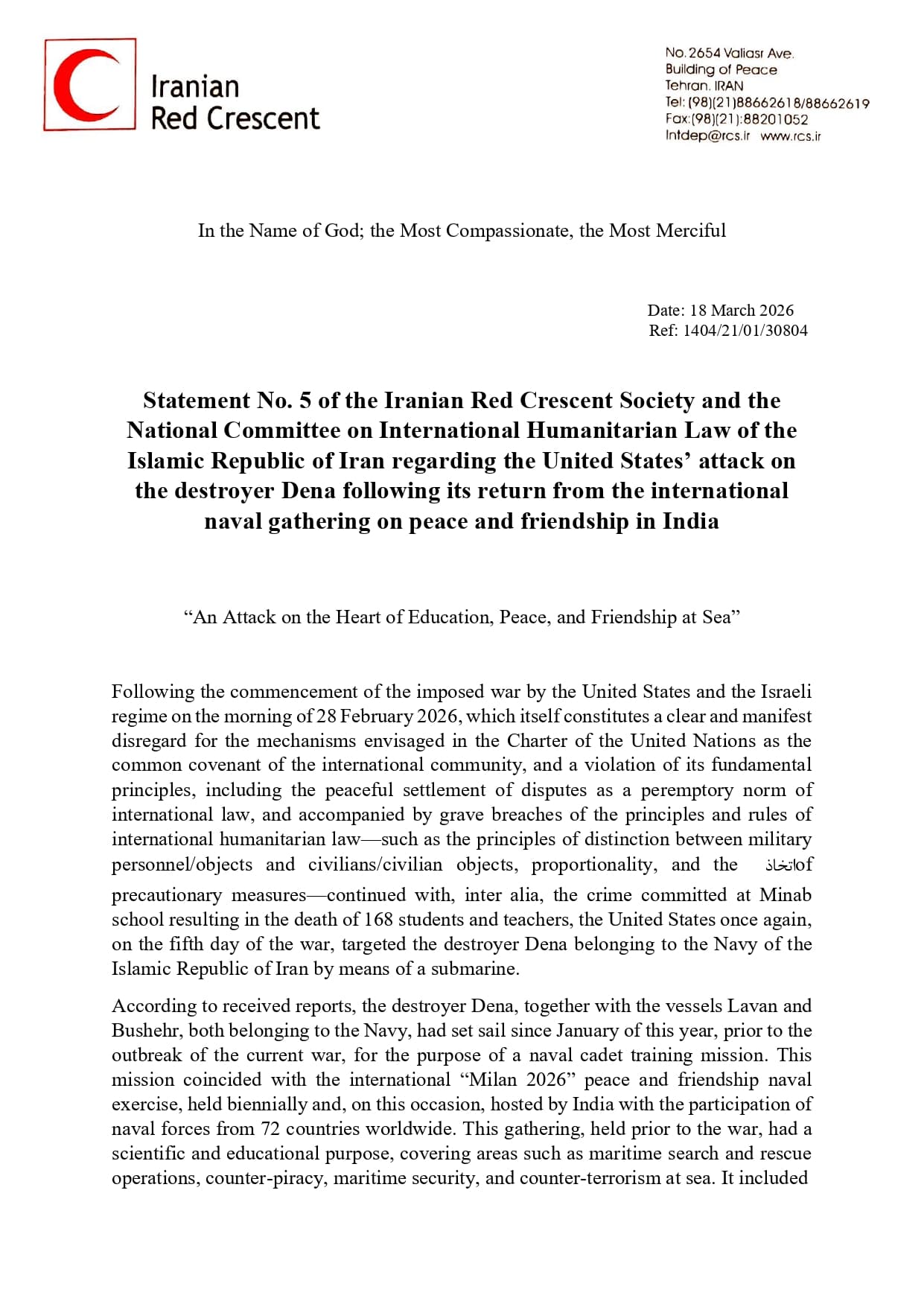
CoI reposts this statement in full as primary documentation of a legally significant incident that has received insufficient international attention.
The Iranian Red Crescent's analysis is notable on two grounds. First, it is procedurally precise: the statement applies the correct legal instruments, Geneva Convention II, the San Remo Manual on international armed conflict at sea, UNCLOS, and the Vienna Convention on the Law of Treaties, to a specific, documented set of facts, rather than issuing a general political condemnation. Second, the statement introduces an evidentiary element that forecloses standard justificatory defenses: the U.S. President's own admission that sinking the vessel was chosen over capture because it was "more entertaining." Under the law of armed conflict, this admission directly negates the military necessity justification and eliminates accident, collateral damage, and technical malfunction as explanations.
Two legal dimensions of the incident warrant particular attention. The attack occurred in the vicinity of Sri Lanka's territorial waters, a neutral state, meaning the strike extended hostilities beyond any recognized zone of conflict and constituted a violation of the law of neutrality independent of any assessment of the vessel's status. Separately, the Dena's deployment predated the outbreak of war by weeks; the flotilla had participated in the Milan 2026 multilateral naval exercise alongside forces from 72 countries. The non-combatant character of the mission was therefore a matter of documented international record at the time of the attack.
The statement situates this incident within a broader pattern of conduct, referencing the earlier strike on Minab school, which killed 168 students and teachers, and calls on the UN, the Human Rights Council, the ICC, and the ICRC to act against what it terms a systemic culture of impunity.
CoI will continue tracking international institutional responses to both incidents.