
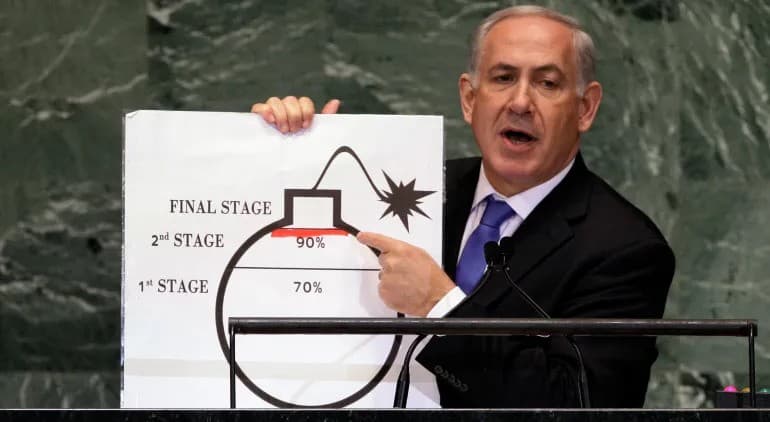
“If we didn’t hit within two weeks, they would’ve had a nuclear weapon” Trump said this to congressional leaders at a meeting on March 4, 2026, six days after the United States and Israel launched their second war against Iran. It was not the last time the American president would say it. In the months after the war began, he repeated the line again and again: to the press, to senators, to European leaders, to everyone. Nor was it the first time. The claim has been made for years, resting on evidence whose reliability is far from clear and which no international body has confirmed. Even the shape and urgency of the sentence, “within two weeks,” is nothing new. In 1992, Benjamin Netanyahu told the Knesset that Iran was three to five years away from being able to build a nuclear bomb. In 2009, he told American lawmakers that Iran would have the bomb within a year, or two at most. In September 2012, at the UN General Assembly, he held up a graphic whose charts and figures put Iran one year away from a bomb. The blog Opinio Juris has reported that Israel has been claiming, over and over, that Iran is close to the bomb since 1984.
Throughout these years, national and international bodies have repeatedly affirmed that Iran was abiding by its nuclear commitments. When Trump pulled out of the 2015 nuclear deal, the JCPOA, in 2018 and reimposed sanctions, not only did his national security team, then headed by John Bolton, fail to present any evidence that the deal had been violated; Yukiya Amano, then Director General of the International Atomic Energy Agency, stressed that Iran had kept its commitments. According to the Atlantic Council, even Mike Pompeo and Dan Coats, officials in Trump’s own administration, acknowledged Iran’s compliance. An agreement that had imposed that level of oversight on Iran’s nuclear program was thrown away, just like that, on the strength of vague claims. Even in the first days of the war, nothing had changed. On March 2, the agency’s Director General, Rafael Grossi, said that no structured program to build a nuclear weapon had been observed in Iran. The next day, speaking to CNN, he rejected the notion that Iran was “days or weeks” away from a bomb. Around the same time, the Arms Control Association concluded that before the February 28 attack, there had been no evidence of an imminent nuclear threat from Iran.
And yet, on the strength of that very sentence, “If we didn’t hit within two weeks, they would’ve had a nuclear weapon”, the United States and Israel resumed their attacks on February 28, in the middle of negotiations. By early April, at least 1,600 civilians, including 244 children, had been killed in Iran. The Shajareh Tayyebeh school in Minab was struck on the very first day. In September, a UN fact-finding mission reported that it had found “reasonable grounds” to believe the United States committed a war crime in that attack.
This is not the first such case. The United States did the same thing to Iraq. In February 2003, Colin Powell told the UN Security Council that Saddam Hussein had trailers that served as “mobile production facilities for biological agents.” Later, in October 2004, Charles Duelfer, head of the Iraq Survey Group, reported that at the time of the invasion there had been neither stockpiles of such weapons nor any active capacity to produce them; the trailers had been used to produce hydrogen for artillery weather balloons. Senator Carl Levin eventually said that every one of the Bush administration’s main arguments for going to war in Iraq had been false. According to a 2018 report by Brown University’s Costs of War project, those same false arguments, which launched the Iraq war, led to more than 182,000 Iraqi civilians being killed directly by the war’s violence.
What is striking about Iran and Iraq is that every report showing these governments’ arguments and pretexts for war to be unreliable was available then and is available now, and these were reports produced by Western institutions themselves. And yet, despite all this, the United States did not leave Iraq until quite recently, and its war on Iran, waged alongside Israel, is still going on. Nor did the IAEA’s findings stop the American president from talking, day after day, about Iran acquiring a nuclear weapon. At this point, we can no longer speak simply of lying or pretext-making. A lie or a false report can be exposed, and that would be the end of it. I think that what the United States has done to these countries involves a kind of “truth-making,” grounded in a set of apparatuses of power, the media among them, whose concern is less to prove the truth than to act on it, and to set in motion the military-economic machines built upon that truth.
What I mean is this: even if the whole world says these arguments and reports are lies, nothing will change until some force is able to stop the war machine, whose truth is whatever Bush and Trump say it is, from operating and advancing. These governments’ truth-making about biological and nuclear weapons justified sanctions, moved aircraft carriers, shook the oil market and profited from its swings, filled Western oil reserves with cheap oil, and in the end took the lives of the people of the Middle East, brutally and without a moment’s hesitation. This is the logic of America’s strategy of truth-making, which advances on unproven assumptions and accusations: a narrative in the hands of a will to military-economic action, which does not merely describe the reality it has in mind or argue for it, but pragmatically “produces” it. This logic closely resembles what Nick Land calls “hyperstition.”
Land coined the concept by combining the words hyper and superstition in an essay-like piece of the same name, published in 1995 1 and later collected in Fanged Noumena (Urbanomic, 2011). Hyperstition is, in effect, a circuit of positive feedback in which a fictional, not-yet-existing idea is invested in such a way that it becomes a force for its own realization. In such a circuit, the question is no longer whether a proposition is true or false to begin with. What matters more is whether the proposition can set social, economic, political, and technological forces in motion, along with, of course, the circulation of information. This movement creates conditions in which the original proposition becomes objectively real, and this new reality is then used as evidence that the original proposition was true all along.
In this sense, hyperstition is not simply a prediction of the future but a way of producing the future by investing in a concrete image of it. At first, an idea has no reality. But because people act on it, that action changes reality, and this altered reality, this world that now moves according to that fictional idea, becomes proof that the idea was real, even if there are thousands of reports to the contrary. The result is a self-reinforcing cycle in which the distinction between “describing reality” and “constructing reality” gradually collapses.
Consider, for example, the sanctions that came crashing down on Iran once again after Trump broke the JCPOA. It was this very economic pressure, together with the other side’s breach of the agreement, that forced Iran to respond in kind, and the United States then turned that response into confirmation of its original claim: that Iran had always been bent on chaos and could not be negotiated with. Now, after all this time and amid all this media clamor, the chronological order of these events is probably lost on the public, and governments can easily push their own agendas forward.
In effect, by setting this circuit of hyperstition in motion, the United States built the world according to the narrative that served it best: a world in which America arrives like a hero to save it from an evil force that can neither be controlled nor negotiated with, while, of course, strengthening the wheels of its military economy and energy economy, along with its political dominance over Europe and the Persian Gulf region. This is Hollywood-style truth-making, built on American hyperstition.
In this self-confirming circuit of America’s Hollywood narrative, one thing has played a kind of hegemonic role, in the case of Saddam Hussein and of Iran alike: the production of something called the element of doubt. It is an element that has never been put to work in the case of Israel, for instance, which has both a nuclear program and nuclear weapons, with no organization overseeing either. Without explaining, say, how the IAEA’s oversight of Iran came to be reduced and how Iran ended up producing large quantities of 60 percent enriched uranium, the element of doubt simply highlights the percentage of that uranium, and Iran becomes a nuclear threat. Feeding on public fear, the element of doubt acts as a facilitator and accelerant in the practical triumph of this American hyperstition.
As I have said, American hyperstition draws on a range of processes. One of them is the economic and strategic interests of other actors, large and small. Weakening Iran, and Iraq before it, has naturally benefited regional energy rivals. But more important is something that is not even happening behind the scenes, so there is no need to speculate about it. The gains that the triumph of the Iranian nuclear threat narrative brings to the United States and to Trump, as he has said in interview after interview, are a continuation of the same gains that came from toppling Maduro: first, seizing energy resources, and second, removing every obstacle to the free flow of a dollar-based economy.
Here, hyperstition is both a propaganda technique for profit on a vast international scale and an instrument of political hegemony. But more than anything, hyperstition itself functions as a kind of infrastructure. What matters, in the end, is who can turn their imagined ideas into objective reality, and that is, of course, whoever holds greater military and economic power. Here, hyperstition, having built a self-sustaining circuit within itself, also becomes, on the outside, the engine of a self-sustaining and self-reproducing circuit: it reproduces military and economic power for those who already hold it. This, of course, raises a question, as it should: how can this cycle be broken? And can it be broken at all?
I don’t think a question like this can be answered in a short piece like this one. Besides, thinking it through requires thinking together. Still, if we want to give it a hopeful answer, I think we have to give up on trying to expose the lies. At least within the information environment we have, such efforts are futile in and of themselves. The experience of Iraq showed us that even when the US government itself admits that the entire operation was based on a false premise, nothing goes back to normal, and American forces do not leave the land.
No counter-narrative can destroy this hyperstition, this self-sustaining, self-reinforcing circuit. In my view, the only way forward is to destroy, or at least weaken, the conditions that produce such a hyperstition by weakening the apparatuses that serve it: decentralizing the information units that make it possible to produce truth in such close proximity to governments, and building a horizontal, proliferating network of independent sources. That means independent media, public archives, investigative journalism, open data, and institutions that produce information and make it accessible not for governments and markets, but for the public. Hyperstition cannot be killed with truth; the ground it grows in has to be dried out. And the way to do that may be a flow of information from the bottom up, one that moves in every direction and allows no grand narrative to take hold.